

Medical Disclaimer
This article is for informational purposes only and does not provide medical advice, diagnosis, or treatment recommendations. Cancer treatment costs vary widely based on diagnosis, stage, treatment approach, hospital selection, and individual circumstances. Patients should consult qualified healthcare professionals and hospital financial counselors for personalized medical and financial guidance.
Introduction
Cancer treatment in 2026 continues to involve both medical and financial planning. Across top-tier healthcare systems, treatment costs vary widely depending on the country, hospital infrastructure, regulatory environment, and type of therapy used.
For patients, caregivers, and healthcare professionals comparing global options, understanding current cancer treatment costs in leading countries is essential for realistic planning and informed decision-making. This guide provides a responsible, up-to-date overview of estimated cancer treatment costs in major healthcare destinations worldwide.
What Determines the Cost of Cancer Treatment in 2026?
Cancer care costs are influenced by multiple factors, including:
- Cancer type and stage
- Treatment plan (surgery, chemotherapy, radiation, immunotherapy)
- Duration of care
- Hospital specialization and technology
- National healthcare pricing regulations
- Insurance vs self-pay status
Because treatment pathways differ significantly, hospitals typically provide cost ranges rather than fixed prices.
United States: Highest Costs with Broad Access to Innovation
The U.S. remains a global leader in oncology research, advanced therapies, and clinical trials.
Estimated Costs (Self-Pay, 2026):
- Chemotherapy (per cycle): $9,000 – $28,000
- Radiation therapy (full course): $32,000 – $75,000
- Cancer surgery: $55,000 – $220,000+
- Immunotherapy (annual): $110,000 – $260,000
Cost Drivers:
- High administrative and labor costs
- Rapid adoption of new therapies
- Complex insurance billing structures
Germany: Regulated Pricing with Strong Oncology Networks
Germany’s oncology care is delivered through university hospitals and certified cancer centers.
Estimated Costs (Self-Pay, 2026):
- Chemotherapy (per cycle): $4,500 – $13,000
- Radiation therapy: $16,000 – $42,000
- Cancer surgery: $22,000 – $65,000
- Proton therapy: $32,000 – $62,000
Germany remains attractive due to predictable pricing and structured care pathways.
United Kingdom: Public System with Private Oncology Care
Private hospitals complement the UK’s public healthcare system for international and self-pay patients.
Estimated Costs (Private Care, 2026):
- Chemotherapy (per cycle): $4,000 – $11,000
- Radiation therapy: $16,000 – $38,000
- Cancer surgery: $20,000 – $55,000
Switzerland: Premium Oncology with Higher Costs
Swiss hospitals emphasize personalized care and patient comfort.
Estimated Costs (Self-Pay, 2026):
- Chemotherapy (per cycle): $6,500 – $20,000
- Radiation therapy: $26,000 – $65,000
- Cancer surgery: $45,000 – $110,000
Japan: Precision Oncology with Controlled Pricing
Japan balances advanced diagnostics with regulated healthcare pricing.
Estimated Costs (Self-Pay, 2026):
- Chemotherapy (per cycle): $3,500 – $10,000
- Radiation therapy: $13,000 – $32,000
- Cancer surgery: $18,000 – $48,000
South Korea: Cost-Effective Advanced Cancer Care
South Korea offers advanced oncology services with international patient programs.
Estimated Costs (Self-Pay, 2026):
- Chemotherapy (per cycle): $3,000 – $8,500
- Radiation therapy: $11,000 – $26,000
- Cancer surgery: $14,000 – $42,000
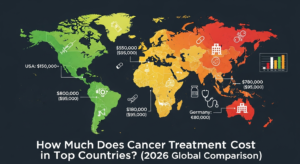
Cancer Treatment Cost Comparison (2026 Overview)
| Country | Relative Cost Level | Key Strength |
|---|---|---|
| United States | Very High | Innovation & trials |
| Germany | Medium | Structured, regulated care |
| United Kingdom | Medium | Integrated oncology networks |
| Switzerland | High | Personalized private care |
| Japan | Medium | Precision & efficiency |
| South Korea | Lower–Medium | Cost-effective advanced care |
What Do Cancer Treatment Costs Typically Include?
Costs often cover:
- Hospital and facility fees
- Specialist consultations
- Diagnostics and imaging
- Treatment administration
Often excluded:
- Travel and accommodation
- Extended rehabilitation
- Additional medications
Patients should request itemized or bundled estimates before treatment.
Insurance Coverage for Cancer Treatment Abroad
- Domestic insurance may not cover international care
- International health insurance may provide partial reimbursement
- Many international patients pay upfront and seek reimbursement later
Hospitals usually provide documentation but do not guarantee coverage approval.
Key Questions Patients Should Ask Hospitals
- What services are included in the estimate?
- Are complications billed separately?
- Is a bundled pricing option available?
- Who manages financial coordination?
Clear communication reduces financial uncertainty.
Conclusion
In 2026, cancer treatment costs continue to vary widely across top healthcare systems due to differences in regulation, pricing models, and access to advanced therapies. Higher cost does not necessarily reflect better care; transparency, specialization, and coordination remain critical considerations.
Patients exploring cancer treatment options benefit from early financial discussions and professional guidance to align medical needs with realistic cost expectations.